A VIRTUAL TOUR OF COOMBE CONDUIT
This is a PowerPoint presentation with notes which is intended to provide a virtual tour of Coombe Conduit, one of Kingston’s most important ancient monuments.

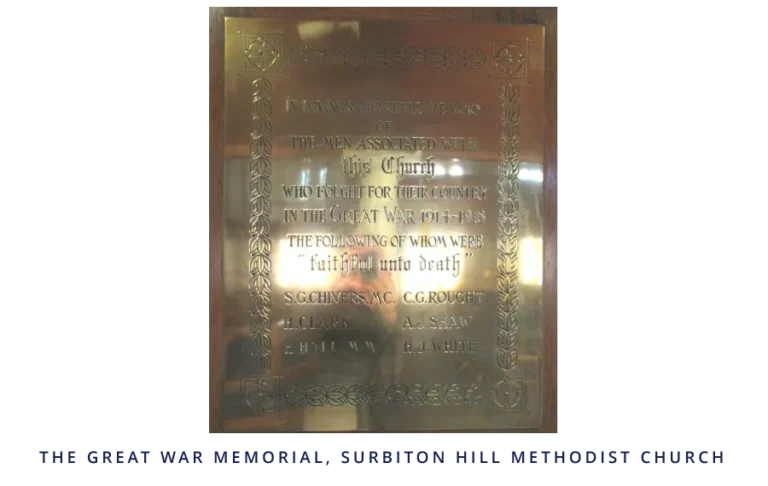
The memorial commemorates six men: two officers and four other ranks who died in the Great War, 1914-1918. Company Sergeant Major Chivers was awarded the Military Cross. Sergeant Hall was awarded the Military Medal with Bar. Private Clark was a member of the Australian Imperial Forces. Private White died of pulmonary tuberculosis in England and is buried in Kingston Cemetery. Lieutenant Rought was a champion rower who represented England in the 1912 Olympic Games in Sweden. He was captured in France at the very end of 1914 and, until after the Armistice in 1918, was a prisoner of war in Germany. He died of food poisoning in London on 31 January 1919, before demobilisation. 2nd Lieutenant Shaw, of the Royal Flying Corps, rose from the ranks, served in Egypt, was Mentioned in Dispatches and was killed in a flying accident in England. He is buried in St Mary’s churchyard, Long Ditton. All men are commemorated on the Surbiton UDC Memorial.
This is a PowerPoint presentation with notes which is intended to provide a virtual tour of Coombe Conduit, one of Kingston’s most important ancient monuments.
The memorial tablet on the wall of St. Andrew’s Church, Surbiton KT6 4AB, has a roll of honour with 53 names of men who died in the service of their country in 1914-1918
In the Spring of 1901 Kingston Debating Society [KDS], founded in 1886, had 48 members, although not all attended the debates held in that season.
A PowerPoint presentation with notes of a talk, entitled “A history of Seething Wells, Surbiton” given to Surbiton & District Historical Society.