CHARLES LOCK LUCK, 1833-1890, A SURBITON ARCHITECT
Charles Lock Luck an architect, born in 1833 at the Paragon, Blackheath, lived in Surbiton from 1860-1890.

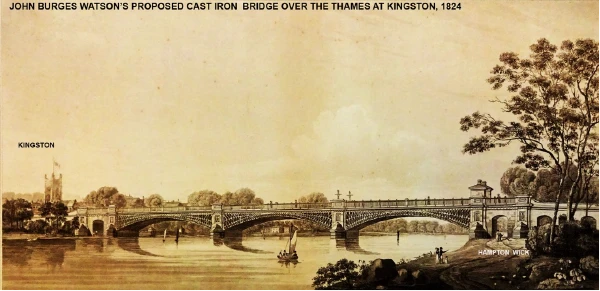
In the early 19th century, the old narrow, wooden Kingston bridge was in a most dilapidated state after centuries of costly maintenance. In November 1824, the Corporation offered a premium of 100 guineas for a design, with a costing estimate, for a replacement bridge in iron with stone abutments. Of about 20 competitors, the winner was John Burges Watson, a young architect. By June 1825, tenders were being sought for the installation of a stone bridge at Kingston, the architect of which was Edward Lapidge. Its foundation stone was laid in November 1825. While the stated reason for the change in direction was the increasing cost of iron, the evidence suggests that Lapidge, the newly appointed Surrey County Surveyor, and other influential persons had more confidence in stone bridges and were unfamiliar with iron constructions. The bridge designed by Lapidge was opened on 17 July 1828 and remains essentially the same today.
Charles Lock Luck an architect, born in 1833 at the Paragon, Blackheath, lived in Surbiton from 1860-1890.
The tombstone of Josiah Clues who died in 1842 was found in Memorial Gardens, Kingston upon Thames, KT1 1RP. Through merit alone, he rose from the ranks to be a Lieutenant in the British Army
A Fundraising Talk In Support Of The Catholic Agency For Overseas Development [Cafod] Given In The Alexander Hall Of St Raphael’s Church, Kt1 2Na, On Palm Sunday, 24 March 2024 By David A. Kennedy, Phd
DISCOVERING THE WAR DEAD OF ST ANDREW’S & ST MARK’S PARISH, SURBITON: BEHIND THE NAMES.