St Mark’s War Dead
DISCOVERING THE WAR DEAD OF ST ANDREW’S & ST MARK’S PARISH, SURBITON: BEHIND THE NAMES.

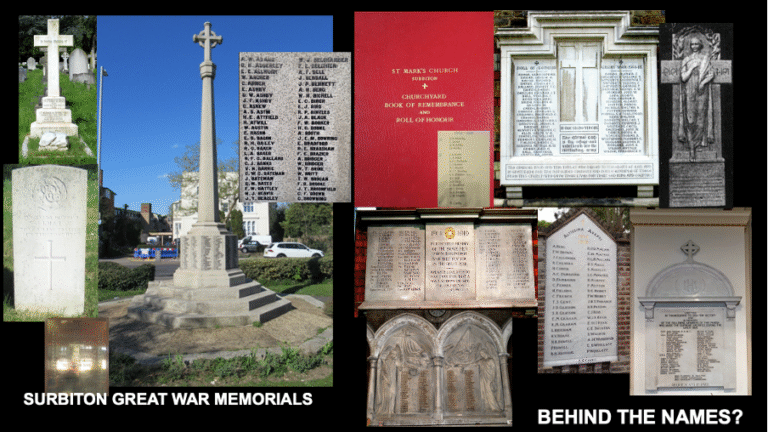
This is a PowerPoint Notes presentation based on a talk given to the Surbiton & District Historical Society on 7 October 2025 and it incorporates comments made during the discussion thereafter. The talk was based on research on the following war memorials of the Great War in Surbiton: St Raphael’s Church [KT1 2NA], St Mark’s Church [KT6 4LS], St Andrew’s Church [KT6 4DS, Surbiton Hill Methodist Church [KT6 6AF], Christ Church [KT6 8JJ] and Shrewsbury House Preparatory School [KT6 6RL]. It also considers the memorial that existed in Surbiton Park Congregational Church, demolished in the late 1960s, the Commonwealth War Graves Commission burials in Surbiton Cemetery [KT6 6AG], other Great War graves in this Cemetery and the Surbiton UDC Memorial, also known as “Surbiton Cross” [KT6 6AG]. How the lists of names on the memorials were drawn up is considered and looking behind them provided a glimpse into the lives and deaths of a lost generation of some residents of the Surbiton area and the different social classes that could be identified. The Great War casualties, in different combat zones, were on an unprecedented scale, including civilian non-combatant deaths, and caused an influx of Belgian refugees to the UK, some of whom were accommodated in the Surbiton area. The conflict introduced new methods of warfare, including air combat, long-distance bombardment, and poison gas. All of these added to the old risks of warfare: being killed by the enemy and disease. An emergent disease, “Spanish Influenza”, raged during 1918 – 1920, and some names on the Surbiton memorials reflect this. More information on the memorials can be found on www.kingstonhistoryresearch.co.uk
DISCOVERING THE WAR DEAD OF ST ANDREW’S & ST MARK’S PARISH, SURBITON: BEHIND THE NAMES.
The Great War memorial of Christ Church, Surbiton [KT5 8JJ] commemorates 76 men, and best matches were found for 60 of them.
A shrine to the Bl. William Way was unveiled at St Agatha’s Catholic Church, Kingston, on 15 August 1971.
The memorial tablet on the wall of St. Andrew’s Church, Surbiton KT6 4AB, has a roll of honour with 53 names of men who died in the service of their country in 1914-1918