REVIEW OF BOOKS ON THE HISTORY OF KINGSTON UPON THAMES.
Reviews on four books covering Kingston, its suburbs and societies…

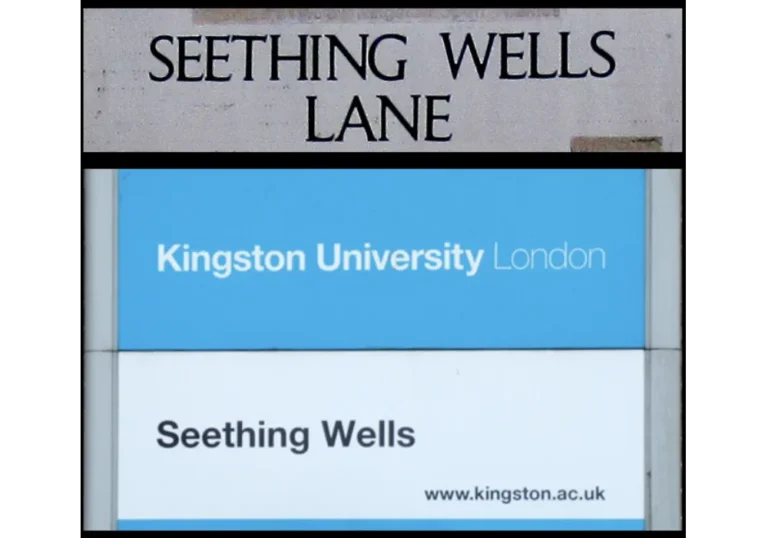
Seething Wells is an area in Surbiton [e.g., KT6 5NP]. According to Richardson [1888], the “Seething Well” spring probably was on land surveyed for the Lambeth Water Company in 1848, prior to waterworks construction, and from it a small stream ran down to the Thames. Ayliffe [1914] observed that at the end of the old Fox and Hounds pub was a building that contained the original well and spring known as “Seething Wells”. Tithe records supported Richardson’s view and identified the old Fox and Hounds pub, according to Ayliffe. They were referring to different features. In a spring, water issues from the surface by itself and possibly may be described as “seething” from the ground. For a well, a shaft is dug to obtain underground water. By 1858, Richardson’s spring had disappeared following the development of the waterworks along the Portsmouth Road. However, a well head can be seen on the derelict Chelsea waterworks and this may have been the well reported by Ayliffe, although it is almost opposite the former Globe pub, which is in Kingston [KT6 5PT]. Perhaps this well was utilised in the waterworks. Possibly, Richardson’s spring was on the derelict Lambeth Waterworks site in Long Ditton, roughly between the existing old Pump House and the junction of Simpson Way with Portsmouth Road [KT6 4ER]. Reports originating in the 18th century that the spring water was warm in the winter while being cold in the summer, or was warm, or was hot, were without evidential foundation. Reports originating in the 18th century that the water was used to treat eye afflictions, such as opthalmia, are reasonable. Belief in the existence of a spa at Seething Wells possibly originated in a version of Wyld’s Railway Guide, published around 1839, to encourage railway tourism. It continued with the wishful thinking of Walford [1898] and was echoed by Butters [2013]. No evidence was found that a spa ever existed at Seething Wells.
Reviews on four books covering Kingston, its suburbs and societies…
In 1816 Alexander Raphael commissioned a sarcophagus for himself in the church of the Armenian Monastery….
On 13 November 1919, an aeroplane named Endeavour took off from Hounslow aerodrome on the first leg of a journey to Australia.
A fundraising Lenten talk in support of “The Bread of Life” charity of the Sons of Divine Providence.